* Product parameters Operating frequency: 20kHz ~ 500kHz, suitable for high - frequency switching power supplies. Output power: 10W ~ 1000W, depending on the operating frequency and core material. Operating temperature: -40℃ ~ +180℃. Storage conditions: -25℃ ~ +85℃, humidity 30% ~ 95% RH. Insulation withstand voltage: Usually requires AC 2000V, insulation resistance ≥200MΩ (tested at DC 500V).
* Product features The core feature of the PQ transformer is that it achieves an almost perfect balance between the excellent electrical performance (low leakage inductance, easy to wind) brought by the “round center post” and the excellent mechanical and heat - dissipation characteristics provided by the “square outer edge”.It has the characteristics of high operating frequency, high efficiency, small size, light weight, etc..
* Typical application fields Information technology and communication equipment Industry and automation High - end consumer and professional electronics Transportation and electric vehicles
* Product standards UL, RoHS, 3C, CQC * Dimensions and specifications 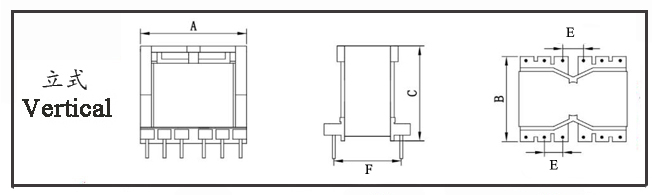
Model | Structure type | Dimensions (mm) | Number of pins | Pin pitch (mm) | Row pitch (mm) | Pin iameter
mm | Remarks | A | B | C | Pin | E | F | PQ32- 001 | Vertical | 33.0 | 34.0 | 21.0 | 6+6 | 5.0/7.5 | 30.00 | Φ0.8 |
| PQ32- 002 | Vertical | 33.0 | 34.0 | 27.0 | 6+6 | 5.0/7.5 | 30.00 | Φ0.8 |
| PQ32- 003 | Vertical | 33.0 | 34.0 | 32.0 | 6+6 | 5.0/7.5 | 30.00 | Φ0.8 |
|
The above are the commonly used bobbin styles of the company.,Other styles are not listed for the time being.,Welcome to consult. Our company can customize high - frequency transformers of various specifications according to customer requirements.
Key Performance of PQ32 Transformer: I. Core Structure Characteristics (PQ Type)
Round Center Leg: The cross-section of the PQ core’s center leg is round. This design improves winding space utilization, reduces the average turn length of windings, and thereby lowers copper loss (winding resistance loss) and leakage inductance.
Oblong (Raceway-Shaped) Profile: This structure provides the maximum winding area for a given cross-sectional area and volume, making it suitable for designs requiring high power density.
Low Electromagnetic Interference (EMI): The round center leg and symmetrical structure help reduce fringe flux and minimize electromagnetic radiation.
High Volume Efficiency: The PQ design aims to maximize power handling capability within a given volume, making it ideal for compact, high-efficiency switching power supplies.
II. Key Performance Parameters and Advantages
High Power Handling Capability:
The effective cross-sectional area (Ae) of the PQ32 core typically ranges from 118 mm² to 162 mm² (depending on specific models such as PQ32/20, PQ32/30, etc.).
Combined with its high saturation flux density (e.g., ~510 mT for modern materials like PC95), it can handle large flux density swings (ΔB). According to the formula P ∝ f × Ae × ΔB, higher operating frequencies enable greater power transmission.
Typical Application Power Range: In topologies such as flyback and LLC, PQ32 transformers are commonly used in medium- to high-power switching power supplies ranging from 100W to 250W.
Excellent High-Frequency Performance:
Paired with low-loss high-frequency ferrite materials (e.g., TDK's PC95, Murata's L250), the PQ32 core is well-suited for operation from tens of kHz to hundreds of kHz (even reaching MHz levels).
High-frequency operation reduces the size of both the transformer and the entire power supply, aligning with the original design intent of the PQ series.
Favorable Thermal Characteristics:
Flexibility:
Available in various "height" specifications (e.g., /20, /30, indicating center leg height), allowing designers to balance power, winding space, and height constraints.
III. Main Application AreasPQ32 transformers are widely used in medium- to high-power applications with strict requirements for size and efficiency due to their excellent power density and efficiency:
Server/Data Center Power Supplies (SMPS): High efficiency and power density are critical requirements.
Telecom Power Supplies: Such as base station power modules, requiring high reliability and efficiency.
Industrial Power Supplies: High-power industrial control equipment, motor drives, etc.
High-End Adapters/Chargers: External power supplies for high-performance laptops, workstations, etc.
New Energy Applications: Auxiliary power supplies or high-frequency isolation sections in photovoltaic inverters and energy storage systems.
High-End Consumer Electronics: Devices with stringent size constraints.
IV. Design Considerations and Challenges
Winding Process:
Due to the pursuit of high power density, the pin spacing of the bobbin may be narrow, requiring high precision from automated winding machines.
Multi-winding configurations, interlayer insulation, and shielding layers require careful design to balance leakage inductance, distributed capacitance, and insulation requirements.
Thermal Design:
High power density implies concentrated heat sources. Copper loss must be minimized through the use of copper foil, multi-stranded wires, and rational winding distribution, while heat dissipation must be enhanced via PCB heat sinks, potting, or forced air cooling.
Cost:
Parameter Optimization:
Design requires precise calculations and trade-offs: flux density swing (ΔB), operating frequency (f), current density (J), window utilization factor (Ku), and temperature rise (ΔT). Air gap adjustments significantly impact inductance and leakage inductance.
V. Comparison with Similar-Sized Cores
Compared to EER/E-Type Cores: At the same volume, the PQ32 can transmit more power or operate at higher frequencies with higher efficiency and lower EMI. However, it is more expensive and slightly more complex to wind.
Compared to RM-Type Cores: Both offer low EMI characteristics, but the PQ core typically provides higher power density, while the RM core offers better all-around shielding (pot-core design).
Core Characteristics of the PQ32 Transformer 1. Intrinsic Characteristics Determined by Structure
Round Center Leg: This is the most distinctive feature of the PQ core. It minimizes the winding turn length, thereby significantly reducing copper losses (winding resistance losses) and leakage inductance, directly improving efficiency.
Race-Track (Oblong) Profile: Provides the maximum winding window area for a given core cross-sectional area. This allows for the use of thicker wire gauges or more turns within a limited volume, enabling high power output or low current density.
Symmetrical and Compact Structure: The excellent core enclosure effectively reduces electromagnetic interference (EMI) leakage, facilitating compliance with stringent EMC standards.
2. Outstanding Performance Characteristics
Extremely High Power Density: This is the primary design goal of the PQ series. Among all 32mm leg-span class cores (e.g., ER32, ETD32), the PQ32 typically offers the highest power handling capability. It can transmit the maximum power within the smallest volume or achieve the highest efficiency.
Excellent High-Frequency Characteristics: Its low-loss geometric structure, combined with modern high-frequency, low-loss ferrite materials (e.g., PC95, L250), makes it highly suitable for operation from tens of kHz to several hundred kHz, or even higher. High-frequency operation is key to power supply miniaturization.
Superior Thermal Performance: The round center leg provides an excellent heat dissipation path for the windings, and the core's own volume-to-surface-area ratio also aids heat dissipation, helping to control temperature rise.
Flexible Design Options: PQ32 cores are typically available in different heights (e.g., PQ32/20, PQ32/30), allowing engineers to make precise trade-offs and optimizations between height constraints, power requirements, and winding space.
3. Application and Usage Characteristics
Targets High-End Applications: Due to its superior performance and higher cost, it is typically used in applications with extremely high demands for efficiency, size, and reliability, rather than in low-cost consumer products.
High Demands on Design and Manufacturing:
Complex Design: Requires precise calculation of parameters like air gap and flux density to balance efficiency, temperature rise, and electromagnetic parameters.
Challenging Winding Process: High-density windings necessitate the use of automatic winding machines and high-precision winding techniques. Implementing multiple windings and shielding layers presents additional challenges.
Cost Profile: The unit cost of the core and bobbin is higher than that of E-cores with comparable power ratings. However, the systemic advantages it offers (e.g., smaller heat sinks, reduced overall volume, higher efficiency) can lower the total system cost.
Typical and High-End Application Areas of the PQ32 Transformer Leveraging its core features of high power density, high efficiency, and suitability for high-frequency operation, the PQ32 transformer is primarily applied in fields demanding extreme performance, compact size, and high reliability, rather than in ordinary consumer-grade products. Below are the typical and high-end application areas for the PQ32 transformer:
I. Core Application Areas1. Information Technology and Communication EquipmentThis is the primary application market for the PQ32 transformer.
Server/Data Center Power Supplies (SMPS): Modern data centers pursue extremely high power density and energy efficiency (to lower PUE values). The PQ32 transformer is a key component in 80Plus Platinum and Titanium-rated server power supplies, particularly in high-frequency LLC resonant topologies or advanced active-clamp flyback topologies, typically within power modules ranging from 150W to 300W.
Communication Base Station Power Supplies: Equipment like 5G base stations and optical transmission devices, often installed outdoors or densely packed in racks, impose stringent requirements on power supply efficiency, power density, and reliability in high-temperature environments.
Networking Equipment: Built-in power modules for high-end routers and switches.
2. Industrial and Automation
Industrial Power Modules: Provide stable and reliable isolated power for PLCs (Programmable Logic Controllers), servo drives, industrial PCs, etc. Industrial environments demand high-temperature operation and high reliability, making the PQ32 an ideal choice.
Renewable Energy:
Auxiliary power supplies and drive isolation power supplies in photovoltaic inverters.
Isolation power supplies for Battery Management Systems (BMS) and DC-DC conversion modules in Energy Storage Systems (ESS).
3. High-End Consumer and Professional Electronics
High-End Laptop/Workstation Adapters: Especially those pursuing compact size and high power (e.g., 100W-240W), such as "Gallium Nitride (GaN) Fast Chargers". High-frequency GaN solutions paired with PQ cores enable remarkable miniaturization.
Professional Audio-Visual Equipment: Broadcast-grade equipment and high-end audio amplifiers require switching power supplies with low noise and high performance.
Medical Equipment Power Supplies: Internal power supplies for medical devices with extreme requirements for safety isolation, reliability, and low electromagnetic interference (e.g., imaging equipment, life monitors). Special attention must be paid to medical certification requirements.
4. Transportation and Electric Vehicles
High-frequency isolation sections within On-Board Chargers (OBC) and DC-DC Converters. The interior space of electric vehicles is extremely valuable, necessitating high-power-density power components.
Auxiliary power supply systems for rail transportation equipment.
II. Application in Typical Circuit TopologiesThe PQ32 transformer is commonly used in the following advanced topologies to leverage its performance advantages:
LLC Resonant Half-Bridge/Full-Bridge Topology: This is its most classic application scenario. The LLC topology inherently enables Zero Voltage Switching (ZVS) for the primary-side switches, achieving very high efficiency. The high-frequency, low-loss characteristics of the PQ32 perfectly complement the LLC topology, making it suitable for medium-to-high-power, high-efficiency power supplies above 150W.
Active Clamp Flyback (ACF) Topology: In the medium power range of 65W to 120W, the ACF topology combined with GaN or advanced Si MOSFETs can achieve very high frequencies and efficiency. The PQ32 is an excellent choice for the transformer in this topology.
Two-Switch Forward, Phase-Shifted Full-Bridge, etc.: Also used in some industrial applications that are somewhat cost-sensitive but still require high performance.
|


