* Product Parameters Operating frequency: 20kHz ~ 500kHz, suitable for high-frequency switching power supplies. Output power: 10W ~ 1000W, depending on the operating frequency and core material. Operating temperature: -40℃ ~ +180℃. Storage conditions: -25℃ ~ +85℃, humidity 30% ~ 95% RH. Insulation withstand voltage: Usually requires AC 2000V, insulation resistance ≥200MΩ (tested at DC 500V).
* Product Features The core feature of the PQ transformer is that it achieves an almost perfect balance between the excellent electrical performance (low leakage inductance, easy to wind) brought by the "round center post" and the excellent mechanical and heat dissipation characteristics provided by the "square outer rim".It has the characteristics of high operating frequency, high efficiency, small size, and light weight..
* Typical Application Fields
Computers and communication equipment: Power modules for desktop computers, servers, network switches, routers, etc. Power adapters and charging equipment: Notebook power adapters, USB PD fast chargers, electric vehicle chargers, charging piles, etc. Industry and new energy: Industrial control power supplies, auxiliary power supplies for photovoltaic inverters, UPS power supplies, etc. Lighting and consumer electronics: LED driver power supplies, LCD backlight power supplies, monitors, smart home devices, etc.
* Product Standards UL, RoHS, 3C, CQC * Dimensional Specifications 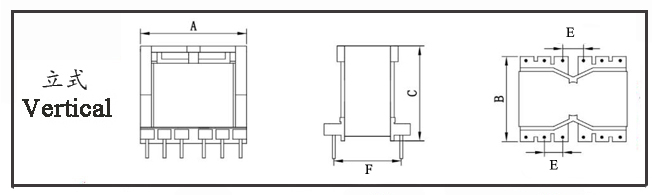
Model | Structure Type | Dimensions (mm) | Number of Pins | Pin Pitch (mm) | Row Pitch (mm) | Pin Diameter
mm | Remarks | A | B | C | Pin | E | F | PQ26-001 | Vertical | 27.0 | 29.5 | 21.0 | 6+6 | 3.8/7.7 | 25.50 | Φ0.7 |
| PQ26-002 | Vertical | 27.0 | 37.0 | 21.0 | 6+6 | 4.5 | 32.50 | Φ0.8 |
| PQ26-003 | Vertical | 27.0 | 29.5 | 23.0 | 6+6 | 3.8/7.5 | 25.40 | Φ0.6 |
| PQ26-004 | Vertical | 27.0 | 29.5 | 26.0 | 6+6 | 3.8/7.5 | 25.40 | Φ0.7 |
|
The above are the commonly used bobbin styles of the company.,Other styles are not listed for the time being.,Welcome to consult. Our company can customize high - frequency transformers of various specifications according to customer requirements.
PQ26 Transformer The PQ26 transformer is a medium-to-low power high-frequency transformer designed for power conversion applications, widely used in scenarios requiring high-frequency operation and high reliability. Its primary performance advantages are reflected in its power density, high-frequency characteristics, and energy conversion efficiency.
I. Core Structure and Advantages
Compact Magnetic Core
The PQ26 model uses a pot-type ferrite core with closed magnetic structure, reducing magnetic flux leakage by over 40% compared to traditional E-type cores. This ensures high coupling efficiency.
Dimensions: Outer dimensions are approximately 26.5mm × 26.5mm × 20mm (L × W × H), suitable for dense PCB layouts and space-limited designs.
Material and Design Optimization
Core material is typically PC40 or PC44 ferrite, offering excellent high-frequency magnetic properties, with maximum operating frequency up to 500kHz.
Optimized core cross-sectional area and winding window design, supporting output power of 20–60W (e.g., 30W/12V output).
Standard Pin Configuration
II. Key Electrical Performance1. Inductance and Coupling Performance
Magnetizing Inductance (Lm) Typical value ranges from 200–500μH (adjustable based on turns), proportional to the square of turns and Ae, and inversely proportional to Le. The PC40 material offers high permeability, ensuring stable magnetizing inductance. It maintains stable current ripple over a wide input voltage range (90–264VAC).
Leakage Inductance (Lk) When using the sandwich winding method (primary-secondary-primary), leakage inductance can be controlled within 10–20μH, significantly lower than open-core transformers. Low leakage inductance reduces voltage spikes in switching transistors, decreases switching losses, and improves power conversion efficiency (up to >90%).
Distributed Capacitance Thin insulating paper separates winding layers, and segmented winding can limit distributed capacitance to below 500pF, preventing resonance at high frequencies and ensuring stable transformer operation up to 500kHz.
2. Loss and Efficiency Characteristics
Core Loss (Pc) Composed of eddy current loss and hysteresis loss, positively correlated with frequency and flux density. PC40 material exhibits a core loss of only 200mW/cm³ at 300kHz, while PC44 material shows a loss of ≤300mW/cm³ at 500kHz. Low loss effectively controls transformer temperature rise (full-load temperature rise ≤35℃).
Copper Loss (Pc) Skin effect is significant at high frequencies. Using multi-stranded enameled wires (e.g., 0.1mm × 10 strands) for winding reduces AC resistance (ACR), keeping copper loss proportion of total loss ≤40%. Total loss under full load is ≤3W, achieving efficiency of 88%–92%.
3. Insulation and Safety Performance
Complies with mainstream safety standards such as UL/CE. Insulation materials use flame-retardant V0-grade polyester film, resistant to high-temperature aging.
Creepage distance and electrical clearance are ≥3mm, suitable for wide-input voltage power products, avoiding high-voltage breakdown risks.
4. Anti-Interference and Environmental Adaptability
The closed magnetic structure provides inherent magnetic shielding, with external electromagnetic radiation ≤30dBμV/m, ensuring no interference with sensitive peripheral components (e.g., MCUs, wireless modules).
Excellent vibration and moisture resistance. After 1000 hours in a 90% RH (40°C) environment, insulation resistance remains ≥50MΩ, suitable for outdoor or humid applications.
III. Performance Optimization Directions
Winding Optimization
Prioritize the sandwich winding method to reduce leakage inductance. For multi-output designs, tightly wind secondary windings to improve coupling.
Use thick stranded wires for high-current output windings and thin enameled wires for low-current windings to balance copper loss and window utilization.
Magnetic Core Air Gap Adjustment
Thermal Design Optimization
Apply thermally conductive insulating varnish to winding surfaces to improve heat dissipation efficiency.
During PCB layout, keep the transformer away from heat sources (e.g., power transistors) and reserve adequate space for heat dissipation.
Core Features of the PQ26 (A-Dimension 26mm) Transformer The PQ26 (A-Dimension 26mm) is a medium-to-low power high-frequency transformer. Based on the enclosed structure of the PQ-type pot core and PC40/PC44 manganese-zinc ferrite material, it emphasizes compact design, high efficiency, and strong anti-interference capability. It is suitable for power levels of 15–30W and high-frequency operation in the range of 100–500kHz. Its core features can be categorized into four groups:
I. Compact Structure, High Power Density
Standardized Small Size: The 26mm A-dimension is designed for medium and small PCBs. Its symmetrical pin layout supports automated through-hole (THT) or surface-mount (SMT) processes, enabling high-volume assembly efficiency. It is ideal for miniaturized power designs in consumer electronics and smart home devices.
Magnetic Circuit Design Advantage: The enclosed pot core structure provides a complete magnetic path with minimal air gap leakage. The optimized ratio between window area and effective cross-sectional area (Ae) allows for a power coverage of 15–30W within the compact 26mm size, achieving a power density over 25% higher than EI-core transformers of similar dimensions.
High Space Utilization: Supports multi-layer windings and multiple voltage outputs (e.g., 5V/12V/24V) without requiring additional volume expansion. It can be directly integrated into small power modules.
II. High-Frequency, Low-Loss Operation and Strong Stability
Material Optimized for High Frequency: Standard PC40/PC44 manganese-zinc ferrite materials are used. PC40 is suitable for 100–300kHz with core losses as low as 200 mW/cm³, while PC44 is suitable for 300–500kHz with losses ≤300 mW/cm³. Temperature rise under high-frequency operation is controlled within 35°C, with a long-term operating temperature ≤120°C.
Excellent Loss Control: The use of multi-stranded wire for windings reduces copper losses caused by the high-frequency skin effect. Combined with the sandwich winding method, leakage inductance can be controlled within 10–20µH, minimizing voltage spikes on switching devices and achieving power conversion efficiency of 88%–92%.
High Parameter Consistency: Core dimensional tolerances are ≤±0.1mm. In mass production, key parameter deviations (e.g., magnetizing inductance, leakage inductance) are ≤±5%, ensuring stable performance in end products.
III. Excellent Insulation, Anti-Interference, and Safety Compliance
High Insulation Safety Rating: Withstands 1500VAC/60s between primary-secondary and primary-core, with leakage current ≤5mA. Normal insulation resistance is ≥100MΩ, with creepage and clearance distances ≥3mm, meeting major safety standards such as UL/CE. Suitable for safety requirements in household appliances and industrial control equipment.
Outstanding Electromagnetic Shielding: The enclosed pot core structure provides inherent magnetic shielding, with external electromagnetic radiation ≤30dBµV/m. It can pass conventional EMC tests without additional shielding covers, preventing interference with nearby sensitive components (e.g., MCUs, wireless communication modules).
Strong Environmental Adaptability: Excellent resistance to moisture and vibration. After 1000 hours in an environment with 90% RH at 40°C, insulation performance shows no significant degradation. Suitable for complex environments such as outdoor and industrial applications.
IV. High Versatility and Design Flexibility
Broad Application Compatibility: Covers multiple fields including consumer electronics (small chargers, smart appliance power supplies), industrial control equipment (micro PLCs, sensor power), and portable medical devices (power for small analyzers). Compatible with mainstream power topologies like flyback and forward converters.
Significant Customization Potential: Output characteristics can be flexibly adapted by adjusting winding turns and grinding the core air gap (0.1–0.3mm). Supports wide input voltage ranges (90–264VAC) and multiple output specifications (3.3V–24V), meeting diverse product requirements.
PQ Transformers are widely used in power supply fields requiring compact size, high efficiency, and reliability due to their core features of high power density, excellent heat dissipation, and strong EMI performance. Their applications can be summarized as follows: Any scenario that pursues "higher power and efficiency in a smaller space" is a stage for PQ transformers. The following are their key application areas:
1. Communications and Data Center InfrastructureThis is the most classic application area for PQ transformers, demanding extremely high power density, reliability, and efficiency from power supplies.
Server Power Supplies (SMPS): Provide high-density, high-efficiency DC power for rack servers and storage devices.
Telecom Power Supplies: Used in base stations, routers, switches, optical transmission equipment, etc., requiring stable operation in complex environments.
Networking Equipment Power Supplies: Such as isolation and conversion modules in PoE (Power over Ethernet) switches.
2. Consumer Electronics and Computing DevicesAs devices become increasingly slim and lightweight, the internal space of high-performance adapters is extremely valuable.
High-End Laptop/Gaming Laptop Power Adapters: Typically rated above 90W, requiring high power handling in a small volume while effectively controlling temperature rise.
High-End LCD TV/Monitor Power Boards: Particularly in LED backlight drivers and mainboard power supply sections.
High-Power Fast Chargers: Used in Gallium Nitride (GaN) fast chargers for smartphones and tablets, where the high-frequency characteristics perfectly match PQ cores.
3. Industrial and Automation ControlIndustrial environments require power supplies with high reliability, wide temperature adaptability, and strong anti-interference capabilities.
Industrial PC/PLC (Programmable Logic Controller) Power Supplies: Provide power for core control equipment in automated production lines.
Industrial Bus Converters: For example, converting 24V bus voltage to various low voltages required by circuit boards.
Motor Drives and Servo Controllers: In isolated power supply and auxiliary power sections.
4. New Energy and Automotive ElectronicsThis is one of the fastest-growing application areas in recent years, with stringent requirements for efficiency, power density, and high-temperature performance.
On-Board Chargers (OBC): Core isolation transformers converting AC to DC for batteries, a typical application for PQ/PL-type cores.
DC-DC Converters: Isolation converters within electric vehicles for high-to-low voltage conversion (e.g., 400V/800V to 12V).
Photovoltaic Inverters: Particularly auxiliary switching power supplies and drive isolation sections in string inverters.
Charging Pile Modules: Internal AC/DC or DC/DC power conversion units.
5. Specialized and High-End Equipment
Medical Equipment Power Supplies: Require the highest standards for safety isolation, low leakage current, and reliability, such as internal power supplies for medical imaging devices and analyzers.
Aerospace and Military Power Supplies: Demand extremely high power-to-weight ratios and reliability in extreme environments.
Module Power Supplies: Standard-packaged isolated DC/DC power modules widely embedded into various systems.
|


