Product parameters
Operating frequency: 20kHz ~ 500kHz, suitable for high-frequency switching power supplies. Operating temperature: -40℃ ~ +125℃ (some models can reach +180℃). Storage conditions: -25℃ ~ +85℃, humidity 30% ~ 95% RH. Insulation withstand voltage: Usually requires AC 2000V, insulation resistance ≥200MΩ (tested at DC 500V).
* Product features The core features of the ETD39 transformer can be summarized as: a general - purpose solution with a heat - dissipation design centered around the "circular center post", which achieves the best balance among the four key elements of "heat dissipation, efficiency, power density, and manufacturing cost" in the "medium - power range" and "high - frequency field".
* Typical application areas
Communication and server power supplies: As the main transformer or LLC resonant transformer, it is used in equipment such as communication base stations and server power supplies, with a power of up to several hundred watts. Industrial power supplies: Used in inverter welding machines, frequency converters, industrial control power supplies, etc., with a power range from several hundred watts to kilowatts. LED lighting and drivers: As the main transformer for LED fluorescent lamps and high - power LED driver power supplies, with a power of up to several hundred watts. New energy and charging equipment: Used as the auxiliary power supply or drive transformer for equipment such as photovoltaic inverters, charging piles, and energy storage converters. Consumer electronics and household appliances: Used in high - frequency switching power supplies for products such as PC power supplies, monitors, audio systems, and chargers.
* Product standards UL, RoHS, 3C, CQC
* Dimensions and specifications 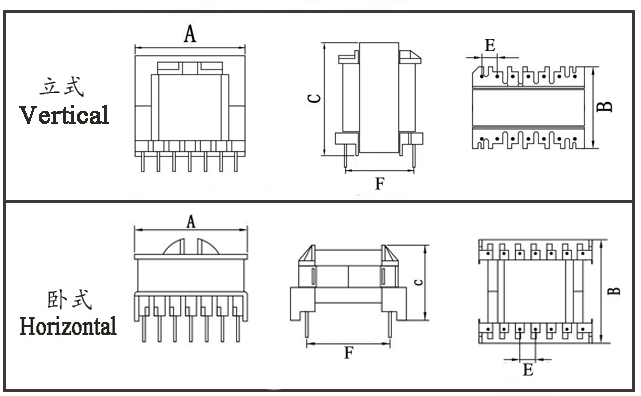
Type | Structure
Tурe | Dimension(mm) | Pin Row (mm) | Row Pitch
(mm) | OD Pin
(mm) | note | A | B | C | Pin | Pin Pitch | ETD39-001 | Vertical | 45.5 | 30.0 | 53.0 | 8+8 | 5.08 | 25.4 | Φ1.0 |
| ETD39-002 | Horizontal | 46.5 | 45.0 | 36.0 | 8+8 | 5.00 | 30.4 | Φ1.0 |
| ETD39-003 | Horizontal | 44.0 | 47.0 | 38.5 | 7+7 | 5.00 | 35.3 | Φ1.0 |
|
* The above are the commonly used bobbin styles of the company,Other styles are not included for the time being,Welcome to consult. Our company can customize high - frequency transformers of various specifications according to customer requirements.
ETD39 Transformer Core Performance The ETD series is a classic and popular core type in transformer and inductor design, with the ETD39 being a commonly used specification. "ETD" stands for Economic Transformer Design, characterized by a cylindrical center post and a rectangular winding window. The number "39" indicates an A‑dimension of 39 mm. 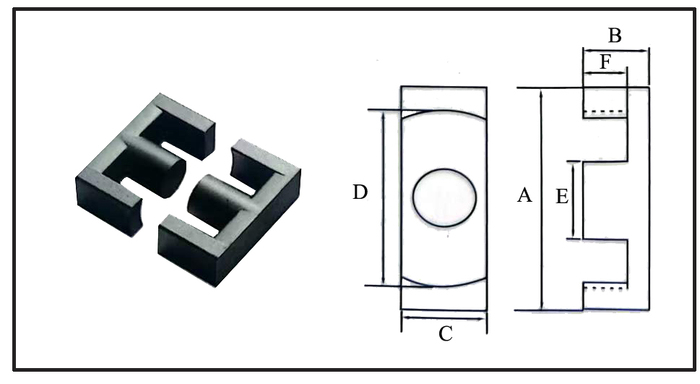
Key Geometric Parameters of ETD39 Core (Typical Values)
A (Outer Span): Approx. 39 mm
B (Core Height): Approx. 19.8 mm
C (Core Depth): Approx. 12.5 mm
Effective Cross‑Sectional Area (Ae): Approx. 126.3 mm² (One of the most critical parameters, determining transformer power capacity)
Effective Volume (Ve): Approx. 11,665.6 mm³
Effective Magnetic Path Length (le): Approx. 92.4 mm
AL Value (ungapped): Approx. 3000 nH/N² (Specific value depends on material, e.g., PC40)
Performance Characteristics and Analysis of ETD39 Transformer1. Power Handling Capability The power capacity of the ETD39 in medium‑ to high‑frequency switching power supplies typically ranges from several hundred watts to about 1.5 kW. The exact power depends on:
Operating Frequency: Higher frequencies allow greater power transfer for a given size (limited by core loss). ETD39 is commonly used from 20 kHz to 300 kHz or higher.
Topology: Forward, push‑pull, half‑bridge, full‑bridge, LLC, etc., each with different power calculation methods.
Core Material and Cooling Conditions: Low‑loss materials like PC95 or PC47 can handle higher power than PC40. Good thermal design also raises the power limit.
Rule‑of‑Thumb Estimate: At around 100 kHz, using common topologies and materials, the ETD39 can reliably handle 500 W–800 W. In LLC resonant topologies, where flux swing is larger, it can exceed 1 kW.
2. Electrical and Thermal Performance Advantages
Low Leakage Inductance: The cylindrical center post enables tight coupling between primary and secondary windings and facilitates interleaved winding arrangements (e.g., P‑S‑P), effectively reducing leakage inductance. This is especially important for forward and LLC topologies.
Excellent Heat Dissipation: The cylindrical center post offers a larger surface area than a square post of comparable size (e.g., EE/EI cores), which helps dissipate internal heat more efficiently. This allows the transformer to operate at higher power densities and temperature rises.
Robust Structure, Easy Winding and Assembly: The two “ears” provide stable mounting and fixing points. The separable bobbin and core simplify automated winding and assembly.
3. Main Application Areas Thanks to its good balance of power and thermal performance, the ETD39 is widely used in medium‑ to high‑power switching supplies:
Industrial Power Supplies: Welding power supplies, motor‑drive power supplies, high‑power LED drivers.
Telecom/Server Power Supplies: Main transformer after PFC or LLC resonant transformer.
New Energy: Auxiliary or drive transformers in photovoltaic inverters.
High‑End Consumer Power Supplies: High‑performance desktop PC power supplies, gaming console power supplies, etc.
4. Design Considerations
Flux Density (Bm) Selection: Set according to core material, operating frequency, and allowable temperature rise. For example, with PC40 material at 100 kHz, Bm is typically set between 0.1 T and 0.2 T (check loss curves) to avoid core overheating.
Window Utilization (Ku): Due to reinforced insulation, margin tapes, etc., the actual copper‑fill factor is usually only 0.3–0.5. The ETD39’s large window area facilitates using thicker wires or multiple strands to reduce copper loss.
Winding Technique: To exploit its low‑leakage advantage, layer‑winding or sandwich winding should be adopted. For multiple outputs or high isolation voltage, winding sequence and insulation must be carefully planned.
Temperature‑Rise Calculation: Both core loss and winding copper loss must be estimated, combined with the core’s heat‑dissipation area, to ensure operation within the permitted temperature‑rise limit (e.g., 60 °C–80 °C).
Brief Comparison with Similar‑Size Cores
EE/EI‑40/42: Similar power capability, but the ETD39 generally offers better heat dissipation and leakage‑inductance control, making it more suitable for high‑frequency, high‑efficiency designs.
PQ Cores: For the same Ae, PQ cores have a taller, narrower window and more compact volume, but may dissipate heat less effectively. ETD provides a better balance between power and thermal performance.
ETD34 / ETD44: The ETD34 handles lower power, the ETD44 higher power. The ETD39 is a classic, transitional size that bridges the gap.
Features of the ETD39 Transformer The ETD39 transformer is a classic and widely used high‑frequency core with distinct characteristics that can be summarized in the following core aspects: I. Structural Design and Physical FeaturesStandardized Dimensions: Signature Cylindrical Center Post:
Core Advantage: For the same effective cross‑sectional area, a cylinder offers a larger surface area than a square post.
Direct Benefit: Greatly optimized thermal performance. Heat generated by the winding is transferred more efficiently to the core through the larger contact area, then dissipated to the environment. This is the defining design feature of the ETD series.
Flat and Wide Window Structure:
The core has a relatively “flat” profile, with a window shape that is wider rather than taller.
Facilitates the use of multiple‑strand Litz wire or copper foil windings, effectively reducing copper losses due to skin and proximity effects at high frequencies.
Provides ample space for reinforced insulation between windings and the addition of margin tapes, making it easier to meet strict safety standards (e.g., creepage distances, insulation thickness).
II. Electrical and Thermal Performance FeaturesExcellent Heat Dissipation (Core Competitiveness):
Combines the thermal‑conductive advantage of the cylindrical center post with its own large surface area, enabling the ETD39 to maintain low temperature rise even at medium‑high power densities. Under the same power conditions, its temperature rise is typically lower than that of PQ or RM cores of similar size.
Optimal Efficiency in the Medium‑Power Range: Outstanding High‑Frequency Suitability:
With high‑performance ferrite materials such as PC40, PC44, or PC95, the operating frequency can cover 50 kHz to 500 kHz+, perfectly meeting the need for high‑frequency operation in modern efficient switching power supplies. This helps reduce the size of passive components.
Good Power Density: III. Manufacturing and Application FeaturesManufacturing‑Friendly Design:
The standardized pin spacing of compatible bobbins is well‑suited for automated winding and wave‑soldering/reflow soldering, reducing costs for mass production.
The symmetrical and robust structure allows the core to be secured easily and reliably with clips or tape.
Broad Application Versatility:
Strong Topology Compatibility: Highly suitable for a wide range of switching‑power‑supply topologies, including flyback, forward, half‑bridge, full‑bridge, and popular LLC resonant converters.
Deep Industry Penetration: It is a “workhorse” core for medium‑power switching power supplies in consumer electronics, industrial control, telecommunications equipment, new energy, and other fields.
ETD39 Transformer: An Overview The ETD39 is a highly classic and widely used high-frequency magnetic core, with its name directly indicating a key dimension: an outer span (distance between the centers of the two outer legs) of 39 mm. It finds extensive application in modern switching power supplies and power electronics, primarily owing to its balanced electrical performance, mechanical structure, and thermal characteristics.
Primary Application AreasSwitching Power Supplies
Mainstream Application: This is the core application area of the ETD39. It is particularly suitable for offline switching power supplies in the medium-power range of 100 W to 250 W.
Specific Products: ATX power supplies for desktops/servers, LCD TV/monitor power supplies, industrial control equipment power supplies, LED driver power supplies, communication equipment power modules, etc.
Power Converters
DC-DC Converters: Used as main transformers or energy-storage inductors in medium- to high-power DC-DC modules for communication base stations, data centers, new energy systems, etc.
Auxiliary Power Supplies for Photovoltaic Inverters: Provides isolated power for internal control circuits of inverters.
New Energy and Industrial Fields
Electric Vehicle On-Board Chargers (OBC): May be utilized in the DC-DC stage of OBCs.
Welding Machine Power Supplies: Serves as high-frequency inverter transformers.
Uninterruptible Power Supplies (UPS): Applied in small to medium-sized UPS units.
Why Is the ETD39 So Popular? (Design Advantages)Optimal Power-to-Size Balance Within the ETD series, the ETD39 occupies a "sweet spot." It offers higher power than the ETD34/29 while being more compact than the ETD44/49, delivering excellent cost-effectiveness and effectively meeting the dual requirements for power density and cost in consumer electronics and industrial products. Outstanding Thermal Performance
Cylindrical Center Post: Compared to square-section cores with the same cross-sectional area, the cylindrical post has a longer perimeter. This translates to a larger contact area between the winding and the core, facilitating efficient heat transfer from the winding to the core.
Flat Profile: The core itself has a relatively flat shape with a large surface area. The window design for bobbin pins allows for better air circulation or contact with heat sinks.
Excellent Winding Process Compatibility
Standardized bobbin pin spacing facilitates automated winding and PCB mounting.
The window is typically "short" and "wide," which is advantageous for using multiple strands of wire or flat copper foil to reduce skin and proximity effect losses at high frequencies. This makes it especially suitable for resonant topologies like LLC.
Superior High-Frequency Performance
Made from high-permeability, low-loss Mn-Zn ferrite materials such as PC40, PC44, or PC95, the ETD39 can typically operate at frequencies ranging from several tens of kHz to several hundred kHz (e.g., 65 kHz, 100 kHz, 150 kHz, and even higher). This meets the demands of modern high-efficiency, compact power supplies.
|


