分享到:

高频变压器PQ40

产品详情
性能
特点
应用

* 产品参数

  • 工作频率:20kHz ~ 500kHz,适用于高频开关电源。

  • 工作温度:-40℃ ~ +180℃。

  • 储存条件:-25℃ ~ +85℃,湿度30% ~ 95% RH。

  • 绝缘耐压:通常要求AC 2000V,绝缘电阻≥200MΩ(DC 500V测试)

* 产品特点

PQ变压器的核心特点是:在“圆形中心柱”带来的优秀电气性能(低漏感、易绕制)和“方形外缘”提供的出色机械与散热特性之间,取得了近乎完美的平衡。具有工作频率高、效率高、体积小、重量轻等特点。


* 典型应用领域

  • 通信与数据中心基础设施

  • 消费电子与计算设备

  • 工业与自动化控制

  • 新能源与汽车电子

  • 特种与高端设备

* 产品标准

UL, RoHS, 3C,CQC

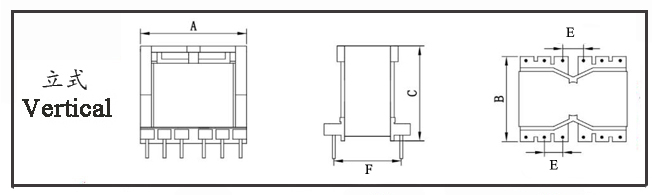
* 尺寸规格

PQ2020 (2).jpg


型号

结构类型

尺寸(mm)

针数

针距(mm)

排距(mm)

针经
mm

备注

A

B

C

Pin

E

F

PQ40-001

Vertical

40.0

44.0

44.0

6+6

5.0/15.0

38.00

Φ0.9


以上为公司常用骨架样式,其它款式暂未列入其中,欢迎咨询。本公司可按客户要求定制各种规格高频变压器。


PQ transformers are high-frequency transformers using PQ-type ferrite cores as their core component, known for their high power density, low loss, low leakage inductance, and excellent heat dissipation, making them suitable for compact and high-efficiency applications such as power supplies.
II. Key Performance Advantages and Principles
High Power Density:
The PQ core’s circular center pillar combined with a compact bobbin improves window utilization by 15%–20% compared to EE cores, enabling a 20%–30% increase in power output for the same volume and supporting slim-profile designs.
Low-Loss Design:
Ferrite cores (e.g., PC40/PC44) exhibit low hysteresis and eddy current losses at high frequencies, with typical losses <200 mW/cm³ at 100 kHz.
The circular center pillar reduces wire bending, lowering DC resistance and skin effect losses, resulting in 10%–15% lower copper loss compared to traditional EE cores.
Excellent Thermal Management:
The large contact area between the core and windings facilitates rapid heat transfer to the housing or substrate. The symmetrical structure ensures uniform temperature distribution, reducing full-load temperature rise by 8–12 K compared to EE cores of similar specifications.
Low EMI and High Reliability:
The closed magnetic path and symmetrical winding reduce stray flux by 30%–50% compared to EI cores, lowering the cost of EMI filtering.
Pins integrated into the bobbin ensure secure installation and high resistance to vibration, making PQ transformers suitable for harsh environments such as industrial and automotive applications.
Key Design Parameters
Operating Frequency:
25–500 kHz, with 30–200 kHz recommended for an optimal balance between losses and cost.
Topology Compatibility:
Suitable for flyback (<200 W), forward, or half-bridge (200–500 W) topologies, offering better adaptability than RM cores.
Air Gap Control:
An air gap (0.1–0.5 mm) is required in flyback topologies to prevent saturation, while forward topologies may not need one. Note that leakage inductance increases with larger air gaps.
Winding Strategy:
Primary winding split into sections, secondary winding placed centrally, and insulation between layers can reduce leakage inductance to below 0.5%.
Performance Optimization Directions
Loss Optimization:
Select low-loss cores (e.g., PC47) to reduce core losses by 25% at 100 kHz. Use multi-strand Litz wire to decrease skin effect losses by 30%.
Thermal Design:
Apply thermal grease between the core and heat sink; add cooling channels within the windings to reduce temperature rise by 10–15 K.
EMI Optimization:
Adopt a sandwich winding method (primary-secondary-primary) to reduce leakage inductance by 40%. Add a common-mode inductor in series with the primary winding to help meet EMI standards such as EN55032.


Four Core Advantages of PQ Transformers
1. Extremely High Power Density (Most Distinctive Feature)
  • Geometric Structural Advantage: The PQ core features a circular center pillar cross-section. For the same cross-sectional area, a circle has the shortest perimeter. This means that winding the same number of turns requires the shortest length of copper wire.


  • Direct Benefit: Copper loss (I²R loss) is proportional to the wire length. Therefore, the PQ structure significantly reduces copper loss, allowing greater power handling in a smaller volume, truly achieving "small yet powerful."


2. Excellent Thermal Performance
  • Short Heat Path: The core encloses the windings, allowing heat generated (from core loss and copper loss) to be rapidly conducted outward through the core itself, which acts as a large thermal conductor.


  • Reasonable Surface Area-to-Volume Ratio: The compact and curved shape provides effective surface area for dissipating heat into the environment.


3. Good EMI (Electromagnetic Interference) Performance
  • Closed Magnetic Path: The symmetrical magnetic circuit structure confines most magnetic flux lines within the core, resulting in relatively low leakage flux.


  • Easy Shielding: The regular shape facilitates the addition of copper foil shields or external magnetic shields, further suppressing conducted and radiated interference.


4. Perfect Fit for High-Frequency Switching Power Supplies
  • Typically made of high-frequency, low-loss ferrite materials (e.g., PC95, PC44), PQ transformers operate very efficiently at frequencies ranging from tens of kHz to several hundred kHz, with low core loss. This is a key characteristic required for the miniaturization of modern power supplies.


Two Major Design Challenges
1. Relatively Complex Winding Process
  • The bobbin window is characterized as "short but wide." This poses challenges for windings requiring multiple outputs, a large number of turns, or thick wire gauges, potentially necessitating more precise winding layouts or segmented winding techniques.


2. Higher Cost
  • Compared to traditional E-type cores, PQ cores involve higher manufacturing and mold costs. They are considered "performance-oriented" components.


PQ Transformers have gained widespread application in fields demanding compact, efficient, and reliable power supplies, thanks to their high power density, excellent thermal performance, and good EMI characteristics. In short, wherever the goal is to achieve "higher power and efficiency in a smaller space," PQ transformers are on stage.
Below are their primary application areas:

1. Communication and Data Center Infrastructure
This is the most classic application area for PQ transformers, where power density, reliability, and efficiency are critical.
  • Server Power Supplies (SMPS): Provide high-density, high-efficiency DC power for rack servers and storage devices.


  • Communication Power Supplies: Used in base stations, routers, switches, optical transmission equipment, etc., requiring stable operation in complex environments.


  • Network Equipment Power: Such as isolation and conversion modules in PoE (Power over Ethernet) switches.


2. Consumer Electronics and Computing Devices
As devices become increasingly slim and lightweight, the internal space of high-performance adapters is at a premium.
  • High-End Laptop/Gaming Laptop Power Adapters: Typically rated above 90W, requiring high power handling in a compact volume while effectively controlling temperature rise.


  • High-End LCD TV/Monitor Power Boards: Particularly in LED backlight drivers and mainboard power supply sections.


  • High-Power Fast Chargers: Used in GaN (Gallium Nitride) fast-charging adapters for smartphones and tablets, where high-frequency characteristics perfectly match PQ cores.


3. Industrial and Automation Control
Industrial environments demand high reliability, wide temperature adaptability, and strong anti-interference capabilities.
  • Industrial PC/PLC (Programmable Logic Controller) Power Supplies: Provide power to core control equipment in automated production lines.


  • Industrial Bus Converters: For example, converting 24V bus voltage to various low voltages required by circuit boards.


  • Motor Drives and Servo Controllers: In isolation power supplies and auxiliary power sections.


4. New Energy and Automotive Electronics
This is one of the fastest-growing application areas in recent years, with strict requirements for efficiency, power density, and high-temperature performance.
  • On-Board Chargers (OBC): The core isolation transformer converting AC to DC for battery charging, a typical application for PQ/PL-type cores.


  • DC-DC Converters: Isolated converters for high-voltage to low-voltage conversion (e.g., 400V/800V to 12V) within electric vehicles.


  • Photovoltaic Inverters: Particularly auxiliary switching power supplies and driver isolation sections in string inverters.


  • Charging Pile Modules: Internal AC/DC or DC/DC power conversion units.


5. Specialized and High-End Equipment
  • Medical Device Power Supplies: Require the highest levels of safety isolation, low leakage current, and reliability, such as internal power supplies in medical imaging devices and analytical instruments.


  • Aerospace and Military Power Supplies: Demand extremely high power-to-weight ratios and reliability in extreme environments.


  • Module Power Supplies: Standardized isolated DC/DC power modules widely embedded into various systems.


+86  022-58333948         +86  15202280664
admin@e-sitong.com
地址:天津市津南区双港镇联东U谷研创产业园12号楼2门501室